Monday, January 13, 2025

David Copperfield


Back in grade twelve, high school, I did a report on David Copperfield for British Literature class, taught by Dr. Eppert (Yes, this public school instructor had a Ph.d). I had already done a report the previous semester on Oliver Twist for Composition class, so Copperfield seemed fair game. I used the same flowery language in the report as I did for the one on Oliver. And not surprisingly, the parts of the novel that held the most interest for me were the ones in which the Murdstones cast their horrid shadow over young David's life, the horrors he later experiences at Creakle's boarding school, and the wretched shoe polish factory, plus his rescue and liberation by his Aunt Trotwood. Beyond that, his adult life with multiple love interest, his budding career, and the machinations of the slimy clerk Uriah Heep, were of relatively less interest, and I rather breezed though the last chapters. Mainly though, that was because time was running out for the actual writing of the report. 

    Copperfield was Dickens personal favorite novel. It was certainly the most autobiographical, its hero becoming a famous author of novels in serial form. I recall in another high school English class being able to answer the question of what the first three words (title of Chapter 1) were: I Am Born. 

    There have been innumerable adaptations of David Copperfield of course, the most famous perhaps being the one back in the 30s starring Freddie Barthlomew as David, and W. C. Fields as Wilkins Micawber. There's an actor with a Dickensian face for you! There was also one 90s version with Harry Potter's Daniel Radcliffe as the young David.  Around the time I first read it and did that report there was an adaptation on the BBC, possibly Masterpiece Theater. Like their previous Dickens adaptations, that production was long and drawn out, and very true to Dickens' text. Copperfield himself is portrayed by three actors, as a child, a pre-teen at boarding school, and a young adult. The most notable thing about to me at the time though was the fact it had Oliver Cotton as Mr. Murdstone. Cotton of course was then known for portraying another famous Dickens villain, Monks in Oliver Twist, so the role was appropriate. He depicted Copperfield's evil guardian to great effect. 

     A bit more jarring for me, though, was the fact that in the 2000 adaptation of Copperfield, Murdstone was portrayed by none other than Anthony Andrews, whom I was most familiar with as having played Sir Percy in the 1982 Scarlet Pimpernel. Now back then, Andrews seemed mostly cast in heroic roles, such as Ivanhoe that same year. I was very surprised one year when watching a previous version of Copperfield, to find Andrews, as a younger actor, cast as Steerforth, David's rescuer at boarding school! Again, an appropriate role. But some time later, Andrews seemed to get regularly cast as a baddie. This happened when he was cast as Professor Moriarity in the 1990 Sherlock Holmes movie Hands of a Murderer. It might have Andrews' talent for a lofty and arrogant personality that won him these roles. As Murdstone, he portrays the the villain's cold, cruel and vicious personality very accurately. 

    The 2000 adaptation of David Copperfield is my favorite of the bunch, even though, of necessity, it runs over some of the details of some parts, like David's experiences at Creakle's boarding school, rather quickly. The adaptation is split into two parts, fortunately, unlike 1982" Oliver. Even though it was filmed in 2000, it has more of the feel of one of the 1980's Dickens TVizations. This was just before adaptations of Dickens novels began to take a turn for the worse, especially, and a bit ironically, the BBC productions, previously known for being meticulously true to the source material. 

Monday, December 30, 2024

The Mystery of Edwin Drood


 It was as year ago, the Christmas season before this last one, that I finally sat down to read Dickens' last and infamously unfinished novel, The Mystery of Edwin Drood. It was one of the few I hadn't read, but I knew about some of it, of course, how a character with an opium problem named John Jasper, was the suspected murderer, and that the alleged victim, one Edwin Drood, simply vanished one dreary Christmas eve. And I knew there had been many uncanonical conclusions to Edwin Drood, including one by Leon Garfield, writer of YA novels about the American Revolution, and one reputed to have been dictated by Dickens' ghost, though the writing styles didn't match up. I'd seen a few scenes of one movie adaptation on youtube, but that had been all. 

     Actually reading the book was a bit of a surprise. Neville Landless, one of the two rivals for Rosa Budd's affection, and his sister Helena are from British-ruled Ceylon (now called Sri lanka), and are presumably at least part native in origin. Now, seeing that clip years ago, I noticed the ethnicity of the brother and sister, and assumed to was a case of "race-swapping" (as was done with a recent adaptation of David Copperfield. It was not. Dickens has been criticized for his supposed lack of sympathy for colonized peoples, but this novel appears to take up the challenge of colonialism. The Landless siblings have experienced British colonialism first-hand, and the rivalry between Landless and Drood involves a spat between them wherein Drood, otherwise a sympathetic character, expresses racist attitudes (though that word was not used then, of course). Modern audiences might be less likely to forgive Edwin his colonialist attitudes then the audience in the time when Drood was written. As said, Edwin is otherwise pretty sympathetic, as he and Rosa are both orphans, are similar to the persecuted young couple often found in romances of this sort--in this case, the obvious villain being Edwin's uncle Jasper, with his obvious but unwanted designs on Rose. 

     Well, Jasper goes missing that Christmas eve, and the descriptions of the night of his disappearance are very rich here, as one might expect from Dickens. Neville, of course, is accosted almost immediately the next morning, having been the last person seen with Drood--and of course, the fact of his being a foreigner, and (presumably) a Southeast Asian. Not that suspicion doesn't also hover about Uncle Jasper, and Dickens' gives a few clues that point to his guilt, especially his reaction to the news from Mr. Grewgious (who had saved Landless for lack of evidence) that Rosa had decided not to wed Jasper's nephew after all.  Edwin Drood's  pocket watch is discovered in the river, pointing to his possible drowning, but no body turns up. Was Dickens indeed hinting at Jasper's guilt, or was he using him as red herring? If not Jasper, who else? Durdles, the local cryptkeeper, who knows secret of disposing of unwanted corpses? Bazzard, Gregrious's clerk, who is a very odd man by his employer's admission? Well, it's just that name sounds a bit odious ( too similar to 'buzzard'), and Dickens like to play with names. 

     Only the two rivels had any clear motivation though, and the 'red herring' character is likely a more or less modern invention. Some of Dickens' works bears similarity to the detective genre, but it didn't really exist as such back then, which means the author was likely not trying to mislead the audience. Then there is (also fairly modern) cliche that the supposed victim would turn up alive, though this, too, seems unlikely.

    Dickens' son Charles is reported as saying as much (that Jasper was indeed the guilty), so perhaps the mystery of Edwin Drood, wasn't all that mysteriously. And yet, being unfinished, we'll never quite no for sure. So there's plenty of fodder here for what could have happened to Drood, no matter what Dickens intended. Again, the challenge to colonialism was quite unexpected. 

Tuesday, July 19, 2022

Anthony Walters as Tim Crachit


 I just happened upon this picture of Anthony Walters as "Tiny Tim" Crachit from George Scott's Carol today. As the picture shows he was suitably pathetic for the role. 

Kim Downer in George Scott's Carol


Here is a post I found about an actor named Kim Downer who was in George Scott's Christmas Carol, I hadn't heard of him, but it looks like he could of played Fred or even Bob Crachit. Those roles were played by Roger Rees and David Warner respectively. This guy was an extra, who fondly recalled having met George C. Scott.

https://www.shropshirestar.com/entertainment/shrewsbury-entertainment/2021/12/15/fake-snow-and-film-stars-when-a-christmas-carol-came-to-shrewsbury/

Thursday, July 14, 2022

The Stephen King Connection?


    Nell Trent                                     Theodore Trenton

Stephen King has often claimed that he intended for Theodore "Tad" Trenton to survive in the novel Cujo, but when he came to the end, he "discovered" that the child did die after all. 

Now back as a teen not long, after I read the book, I just supposed that to be rot. I mean, perhaps he met that metaphorically, or he thought it was the ending that "worked." But in fiction the author is tottally in control. he is what ultimately determines the fate the characters. SK wasn't always consistent when he  said "I had to kill him off" or "I did it. I'm not totally glad I did it but..", versus "He died on his own."

The author is in control in fiction.

Or is he?

But if King didn't ultimately determine the Tadder's fate, then who or what did?

If you take it literally that it wasn't King who did, then we're talking in the realm of God or Fate. Something like that.

And God of Fate, in other words mysterious forces that control what happens, and are at least sometimes beyond human control is something I've grown to believe in. How much control do we really have? The same certainly would apply to authors, what books get written, or finished, and what fictional characters survive and which do not. 

Another perhaps equally infamous child death was that of "Little Nell" Trent of Dickens' The Old Curiousity Shop. Readers on both sides of the Atlantic were on the edge of the seats waiting to see if thirteen-year-old Nell would survive. Dickens disappointed the majority of them, of course. Was it for the best, artistically speaking? Dickens, had his reasons, of course just as King did. In this case, its said that he didn't want his child characters to grow up and be corrupted. But of course, many of them did survive, while others did not. He very nearly kills off Oliver's aunt seventeen-year-old Rose as well. I'm not sure what made him decide to spare her life in the end, but he seemed to be disturbed by the deaths of fragile young girls and women, yet was impelled to include it in fiction, something like his friend and contemporary, Edgar Allen Poe, influenced by the death of his young mother, and one of his girlfriends. 

The fact Nell is a girl-child undoubtedly had something to do with it. Purity and innocence was and is even today, valued more highly in the "fairer sex." Then again today that might be considered a bit sexist, which wouldn't make Dickens motivations for killing her very reputable. But just how much control did Dickens(or King) have anyway, even though they personal motives? 

The fact that both Little Nell and Theodore have almost the same last name is strikingly odd. King is today's nearest analogue to Dickens, in terms of popularity, output, depth of character and intricacy of plot. Dickens confined his weird elements almost entirely to his ghost tales (there's more of those than just Scrooge, in case you didn't know), and King does not, but in sheer scope, the two authors clearly rival each other. the descions such influential authors make concerning the lives and deaths of their characters is enough to influence popular culture, and culture as a whole. 

The authors had their own personal demons. But why did they have those personal demons in the first place?

The deaths of Nell and Tad seem to parallel on another. Does this in fact mean they were also predetermined? 

Perhaps King little less control in killing off the Tadder than he even guessed.

Saturday, October 16, 2021

Dan Simmons' Drood


 I can't believe I've never made a post on Dan Simmons' Drood!

This was a novel I read some years ago. Dickens' Mystery of Edwin Drood, was of course his final (and infamously unfinished) novel. Though I do remember reading somewhere that one of Dickens notes or letters strongly suggests that Edwin Drood, who had mysteriously vanished during the Christmas season, had been murdered by John Jasper. Many have tried to wrap up the story, including Leon Garfield, I beleive, but the canonical end will foreer remain a mystery. 

The "Drood" character of Simmons' novel, however, is unrelated to young Edwin Drrod, the character Dickens created, save possibily it's hinted that that's where Dickens got the name. It centers around the infamous train ride, on which Dickens was returing to London with his mistriss. After the famed accident occurs, Dickens does his best to help the injured passanngers. According to Simmons' novel, it is then that the author meets the title character, a bizarre vampire-ish fellow with white dead white skin and a gaping aperature for a nose, who introduces himself merely as Drood. This strange personage, helps Dickens help the injured, though he seems somehow to hover through the air from person to person. 

The tale is narrated by Dickens' friendly rival Wilkie Collins, author of The MoonStone and other works of mystery and wierd fiction. It's clear from the start that Collins harbers a strong resentment of his friend for being far more famous, and partiularly hates how Dickens has become known as "the inimatable." Still, he sticks by Dickens through the final faze of his relatively short life, when his travels and readings (particularly "Sikes and Nancy"--and I still have no idea why Dickens took it on himself to act out this particularly horrid scene repeatedly on stage) were taking a toll on the author's health. 

Dickens has a few more encounters with the mysterious Drood, once seeing him floating outside his window! It is never fully explained whether Drood is actually real, or a figment of the author's overwrought imagination. Who or what is he? If a hallucination (or perhaps even if not) is Drood a manifestation of


Dickens's failing health or anxiety? Or perhaps his guilt over having an affair? Has the apparition come into being as the result of the strain of writing? Simmons does not tell us, which makes it one of those stories where it's ultimately up to the reader to decide.

Drood provides a fascinating glimpse into the mind of an aging literary genius, but no concrete explanations for its elements of the surreal.

Wednesday, September 29, 2021

Great Expectations (1980)


By the ninth grade junior high, I was now becoming fairly well versed in Dickens, or at least knowledgable about his works. This was mostly thanks to the TV adaptations of the time. Those were ones I grew up with and remain favorites of today. There was A Tale of Two Cities in 1981,followed by Oliver Twist, in 1982 both sponsored by the CBS reading program. Then in Ninth grade, our English teacher had us read the entireity of Dickens' Great Expectations. Already primed to Dickens by Oliver, I embraced this new tale of another poor orphan horribly treated by his disturbed sister and her pompous friends, even at Christmas (which was not so Jolly in this Dickens yarn). The story opens with the orphan being horribly and graphically threatened an escaped convict. I think I got somehow that this convict really wasn't a villain, in spite of his manner and appearance. And that there really was no psychotic child-murderer hiding out with him. One thing I definitely saw coming was it was Magwitch who had been Pip's unseen benefactor all along. However, rather embarrassingly, I didn't get until after the fact that Pip had been as sure as anything that Miss Havishham was his true benefactor, and was doing so with the prospect his marrying Estella. I thought of it as another story of a poor boy making it rich, and I didn't really get the downside of the story, nor Dickens strong critique of class snobbery, which he himself was guilty of in his younger days. Later of course, I came to appreciate all of this, starting when a college professor stated the irony that Great Expectations was the one Dickens novel where there were no true great expectations.
    It was around the same time that I read the book for class (ninth grade), that I came upon this edition of the novel in a Waldons or B. Dalton Bookseller. The actors from the BBC production, which had aired a couple years earlier, looked exactly as I'd pictured them. Especially Pip with his British cap. I didn't get to see this version until years later, though I did see BBC adaptations of A Tale of Two Cities and David Copperfield.  I managed to order a copy from a video store and (Oh! this is embarassing!) I thought it was the wrong movie because on the cover, Pip wasn't wearing his cap, and I had it sent back! I later discovered my error, and either reordered it, or found it at Suncoast, which at time carried classic British productions. 
   Like every other BBC Dickens adaptation of the time, it is very meticulous, almost going too far in the other direction from adaptations that whittled Dickens thick novels down to two hours. Unlike some more recent adaptations, it is indeed very faithful to the tale. At least one recent version got rid of Orlick, a major antagonist, and the source of Pip's sister's madness. Worse, some other adaptations have gotten rid of Compeyson, which leaves a major part of the story unexplained, since Compeyson is basically the root source of all the trouble in the story. My one beef with the 1981 version, is that even though Compeyson still has a major role, it's never established that he's the same one who deserted Miss Havishham on her wedding night. 
    The BBC Dickens movies of the 2000s somehow took a dark, edgy turn, and the atmosphere of the Great Expectations one is one the darkest. The atmosphere is intentionally made gothic, nearly suggestive of a horror movie. And despite the darker moments in of Dickens, I still wouldn't call it that. 
    One a side note, the 1981 version sports what I consider the bet (meaning the most truly hateable) portrayals of Bentley Drummle, Pip's rival, played by Iian Ormsby-Knox. Much later, Mr. Omrsby-Knox and I became friends on facebook. When I asked if he was one who played Drummle, he acknowledged that, "I did, indeed!" 


Tale of Two Cities (1981)


 As a young child, I really didn't know of anything by Dickens other than Scrooge. In fact, I sometimes wondered if this man had ever written anything else. My first real exposure of Dickens beyond Scrooge was A Tale of Two Cities, in the then-current issue of Scope magazine, a publication for junior high kids. 

   At first I didn't care for the tale, because I small peasant boy gets run over by a callous noble in a carriage. Gaspard, the poor child's grieving father, later climbs into the marquis's bedchamber and murders him (I recall this scene vividly from the movie when it aired), but is caught and executed. The fault of the Marquis de Evermonde (for that is who it is, of course,) is not so much that he hit a child (that was an accident) as his callous response to it. I hated the deaths of children even back then. What's more, I really didn't understand most of the story, or it's political and ethical significance, including Carton's noble sacrifice at the end. I was just sad he got executed. I recall there was a paperback at the time that contained stills from the movie. 


The movie stars Chris Sanderson in the duel roles of Charles Darnay, the innocent heir to the Evermonde family, and Sydney Carton, the man who becomes his savior. And also Peter Cushing as Dr. Marnette. I can't recall the name of the actress who played Madame Defarge, but yes, that's her on the cover of Scope, and she does a marvelous job of being embittered and vengeful at what was done to her family by the Evermondes. DeFarge is, in fact, a very well crafted depiction of someone who has embraced whole heartedly the concept of collective guilt. She and her fanatic cohorts go well out of their way to use Manette's diary to convict Darnay of the crime of--basically, being an Evermonde. She even goes so far as to seek out Darnay's wife and young child to murder them before her fatal struggle with Miss Pross (Tell the fire and wind where to stop! I will have them all!) Even her husband, who rather grudgingly puts up with Darnay's conviction, rebels at this. A more devastating depiction of the evils of scapegoating there never was. 

Some years later, when the Clive Donner production of The Scarlet Pimpernel became my favorite of all movies, I tended to think of it as a Dickens movie, even though it was not. Pimpernel,was after all, part of my "big three" of Donner adaptations, long with Twist and Carol. All of these had scores by Nick and Tony Bicet, and some of the same actors had roles in each of them. Like Tale, Baroness Orczy's Pimpernel series relied very much on the concept of innocent people wrongly condemned merely for having been born into the former ruling class. Orczy was, admittedly, biased on the side of the aristos; she was a member of the Austrian aristocracy herself, and there was, as I recall, a rebellion when she was young, and she feared what might happen if it were taken too far. The villains in the Pimpernel novels, are not, for the most part, the starving and vengeful underclass, but the ambitious bourgeoisie, including Robespierre and Chauvelin who are primarily motivated by power, and use the rage of the disenfrancised to attain it. 

 Dickens, though, depicts terrible atrocities wrought by both callous and privileged aristos and fanatic revolutionaries. He crafts an accurate and disturbing portrait of human psychology, personified primarily in Madame Defarge. Through her, we are shown how and why humans are given to revenge and scapegoating. Even Dr. Manette's diary shows that even he, when imprisoned by the Evermonde's pens something in rage which he will later come to regret. Orczy never really goes that deep.

I didn't actually read Tale until college (though not for a class--they never seemed to have good classes on Dickens at Purdue), and a still remember haunting passages. One of the finest was during the real Darnay and family's flight from Paris: Look back, see if we are pursued!...the whole wild night rushes after us...but we are pursued by nothing else.

On a side note, I don't know much further about Chris Sanderson's acting career, but he did play the Frankenstein Monster on a Thanksgiving afternoon special. It was so dark and morbid I had to turn it off. Which I later learned was why it was so much truer to the original than most of the movies!


Friday, September 24, 2021

James Goldman's Oliver Twist movie Script


Today, I finished reading the Oliver Twist screenplay by James Goldman. This is the second draft, written in 1981. Filming with cast and crew began that fall, and you can see th fall leaves in some of the scenes. Nick Davies, the actor who played Dick, Oliver's fellow workhouse who tragically dies in the book, stated that there were several deleted scenes, including a long scene of dialogue between Dick and Oliver after being shut up in the cellar. Here are the deleted and scenes and major differences in the screenplay from what actually reached the screen:
1)The screenplay is more violent, as Bumble actually slaps Oliver for asking for more, knocking him to the floor. Later, Sowerberry also strikes Oliver after he breaks Claypole's nose.
2) After Oliver and Dick are thrown in the cellar, there is a long dialogue between them. They fear rats in the cellar, and Oliver swears he's get even with Bumble some day--as he does!
3) They pour a bucket over Oliver to wash him before he goes before the board.
4) Oliver says farewell to Mrs. Corney beofre he goes to live with the Sowerberrys. Mrs. Corney seems nicer here than in the book, where she's the one who becomes Mrs. Bumble.
5) Noah Claypole argues with Sowerberry about giving the part of silent mourner to Oliver instead of him (same as the Scope magazine teleplay for junior high).
6) Before running off to London, Oliver meets Dick a final time at the workhouse. The two children embrace, and say farewell to each other, just like in the book.
7) Oliver shows sOliver is seen rumaging through a garbage heap for food. He flees when a dog scres him off; in the later Detroit Times version, Oliver scrambles through fence first of an inn, then scrambles back to get away. THis was definitely a deleted scene, as you can see from the picture.
8)The script states outright that Oliver considers waking up the family before the burglary (again, like the book), before Sykes warns him not to even think of it.
9 In the final movie cut, Rose is teaching Oliver arithmetic in the scene before Oliver sees Fagin and Monks at the window. )In Goldman's script, Rose and Oliver are reading the Adventures of King Arthur and the Knights of the Roundtable. Oliver asks her what a "liege" and she departs to fetch a dictionary. Oliver then continues reading by the garden window. Lancelot and Merlin casting spells on dragons are mentioned before Oliver notices the two stalkers and screams.
10) In the movie, Mrs. Bumble notes that Monks does not look like Oliver's mother, even though he claims she was his sister (he's lying). In the script she notes that while Monks is dark, Agnes is a ash-blonde as Oliver. This shows Richard Hill had already been cast as Oliver when he wrote this.
11)In the final movie cut, Rose is teaching Oliver arithmetic in the scene before Oliver sees Fagin and Monks at the window. )In Goldman's script, Rose and Oliver are reading the Adventures of King Arthur and the Knights of the Roundtable. Oliver asks her what a "liege" and she departs to fetch a dictionary. Oliver then continues reading by the garden window. Lancelot and Merlin casting spells on dragons are mentioned before Oliver notices the two stalkers and scream.
12) At the very end, the script contiains this line of dialogue: :"You have given me my father and my mother. I'm not an orphan anymore. I have a name." Rose and Mr. Brownlow
each take him by the hand. They walk to their carraige togather.
There is no sign of the scene in which Brownlow and Rose are talking over Oliver's head on the lawn, or the one that shows Oliver and his new family gathered outside their estate.
According to Nick Davies on Youtube, there was deleted dialogue where it's brought out that Dick had died. There is none such in the script, at least this version.
James Goldman's script is very very beautifully written, and also brings out the suffering Oliver has to go through even more than the movie.


2
4 Comments
Seen by 17
Like
Comment
Share

Tuesday, March 28, 2017

The Dickensian


Dickensian

   I finally did  get to see the Dickensian a while back; in fact I own it! But while it's a bit sad it only lasted one season (and they they didn't even let as Americans see it), it could have been a lot better than it was.

   This is perhaps the ultimate Dickens crossover, alternate universe fiction. The assumption here is, as with some of my own fiction, that all of Dickens characters inhabit the same reality, and those characters from separate novels can even interact. This has been hinted at before, as with a "Mr. Brownlow" in the most recent version of Bleak House", and Mr. Micawber and Uriah heap showing up in "The Escape of the Artful Dodger."

    I'm grateful they didn't include characters from authors other than Dickens, so we can assume it's a "Dickensverse." I might assume that Dickens himself does NOT exist here, as there is no cameo by him, as happens in some other pastiches.

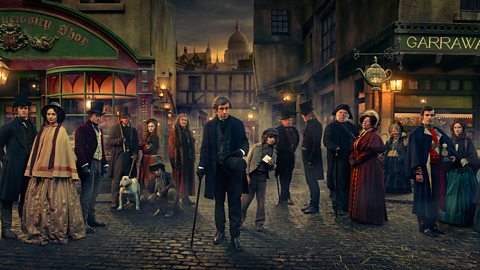
   There are a number of clever and amusing storylines which intersect with each other. A major one is that of Inspector Bucket (he's the gent in the center of the pic above) of Bleak House, solving the suspected murder of Jacob Marley. It's a bit of a cliche (though it works well here), that a murder victim was a jerk whom nobody cared for, and may have brought it on himself. But it's still murder, and Bucket has a job to do. His partner Scrooge, Fagin, whose had some dealings with him, and Crachits are all suspects. The inspector at last arrives at a conclusion where he is faced with the dilemma of responding to the demands of his profession, and "bending" the rules slightly in order to take a course of action that seems the most ethical.

    The other major thread is that of Compeyson, the scroundrel who abandoned Miss Havishham in Great Expectations, and goes into detail with his collaboration with Arthur Havishham. Compeyson is still evil here, but he also appears to have some real feelings for Miss Havisham, and it's her relatives who seem even more at fault than he is for what we know eventually happens. Arthur is the trully evil one.This makes the main villain at bit sympathetic; at one point they have him threatened and by Bill Sikes! This works as drama, though I rather doubt that's the way Dickens would have it, as he rendered Compeyson as unrepentedly evil, as I remember it.

    Mr. and Mrs. Bumble are also present, and married before Oliver Twist himself arrives on the scene, late in the series. This is bit of intentional cheating, as it wasn't that way in the book. It doesn't get really bad, however, until right near the end when they knew for sure the show would be cancelled: Oliver asks for more in front of the Bumbles, during a meeting with Grandgrind, Bounderby, and some other characters making cameos from Hard Times. It makes since that the like of Gradgrind and Bumble would be acquainted, but Oliver's shining moment didn't happen like that. Sure, plenty of Twist adaptations deviate too, but not so much as this, and the trick with this sort of mash-up is to have the characters interact without deviating from their canonical storylines. The final scene in which Oliver meets Dodger outside Scrooge's house, presumably when Marley's Ghost shows up, then leads him into the Three Cripples, also deviates so far from the book it's not even funny. The actor playing Dodger looks nothing like him, as he's played by an African or Indian boy. The actor playing Oliver is well chosen, save that he's a little too young; I fist thought this was taking place some years earlier than when Oliver is sent away, but the ending makes clear that's not at the case.

   Or maybe they were just getting sloppy at the end, as I rather suspect. All of the adult actors look their part, and do their jobs well. But what there is of Oliver has been totally butchered.

    And that's about it for the Dickensian, both good and bad.

Richard Charles in The Secret Garden


   This is the only picture from a musical stage version of Frances Burnett's The Secret Garden. I still have a couple versions of that I saw years ago. This one was performed at Salisbury Theatre in 1983, one year after Oliver Twist 1982. Colin Craven looks very like Oliver Twist in that movie--as much so as the dauphin in Clive Donner's The Scarlet Pimpernel!
    Charles was on stage for more than he was ever on screen. Colin Craven, the young invalid heir to Mistlethwaite Manor, was one role he would fit nearly as well as that of Oliver Twist and Louis-Charles Capet. I've seen many versions of The Secret Garden over the years with the roles played by other actors. The Charles version was, of course, stage only and was never filmed.

The "lost scene" of 1982's Oliver Twist


    The "Reading Program" version DOES explain the deleted scene where Oliver is seen ducking under a fence. It occurs after Oliver flees Sowerberry's coffin shop, and before his meeting with Dodger. Oliver finds an old ramsackle inn, where a man is putting out the garbage. He is so starved that he squeezes through the fence in hopes of snatching some discarded food from the Inn. A mangy, starving dog bars his teeth at Oliver, and Oliver scrambles back through the fence. The scene was filmed, because there's the picture. A small incident, but it's shame it was cut, as it shows how wretched Oliver's prediciment was, undoubtedly why Goldman put it in, and believe me, his script does not shy away from such things, no more than Dickens.

Oliver Twist 1982 CBS Reading Program

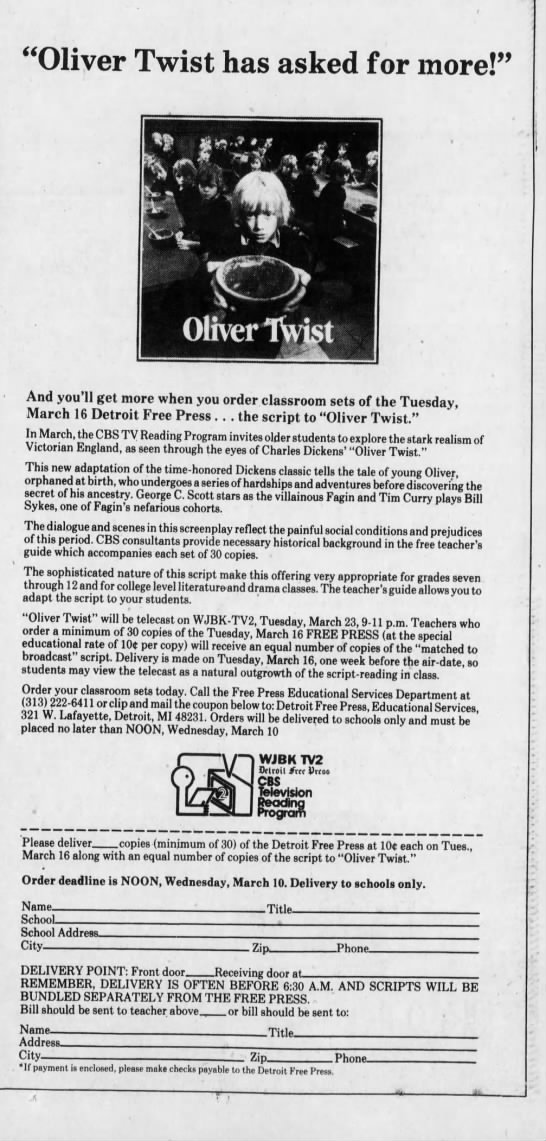
   Image may contain: 1 personLast November I found this in a newspaper archive. I knew that back in the early 80s CBS had a "read more about it" program, and they sponsored film adaptations of classic like Dickens' "Tale of Two Cities," Walter Scott's "Ivanhoe" Kipling's "Kim" among others including George Scott's Christmas Carol. For "Oliver Twist" at least, they went a step further and offered a special reading program sponsared by Red Lobster, and available to teachers only. This small booklets were availabel for a limited time, and contain ALL of James Goldman's final script for Oliver. Even though I'd still want to get a hold of one Goldman's originals, I finally got to actually read. It turns out that Goldman is a very beautiful writer, meaning that he also doesn't not shy away from some of the emotionally heartrending, and really grimy, gritty parts of the story! 

Image may contain: 3 people


Image may contain: 1 person
 No automatic alt text available.


Oliver Twist Party


    It's almost the anniversary for 1982's Oliver Twist. Back then, this article was published in Screen International ,a British publication, at the time the movie was released on American television. The producers and actors threw this party in honor of the film's release. Richard Charles, the boy who brought the definitive version of Oliver to life, is caught in a rare moment off-screen. He apparently attended the party in-character, wearing the aristocratic get-up he wore in the film after Oliver's rescue, when he accepted a charity award for his performance, from Ward Thomas, chairman of Trident Television. I'd never heard of him, though I know of Norton Romsey, Twist's co-producer, but I didn't know he had a title until now. Cherie Lunghi who played Nancy, and Eileen Atkins (Mrs. Bumble), and Oliver Cotton (Monks/Edward Leeford) are also in attendance. An actress who was uncredited (I do remember her scene) also came in character as a Victorian street flower girl. Ted Child's the film's other co-producer is there. Absent, at least in the photos, are the others, including Tim Curry, and George C. Scott, who had top billing as Fagin. I'm guessing Scott was in America at the time. The same might have been true with Curry. Even though he's British, Curry spent a lot of time in America, as I recall, and was working on (or maybe had finished) playing another villain in a screen version of Annie at the time. "Timothy Corrie" is someone entirely different.
     
      One other thing: I wonder why the heck Clive Donner isn't here. He directed, he's British, so he'd surely be in attendance.

Wednesday, December 16, 2015

A Canonical Dickens Crossover: Master Humphrey's Clock


Here is something that over Dickens fans may have noticed, but I had not. There appears to be at least one canonical crossover or "shared universe" fiction in the Dickens canon. Accordng to my friend Jeff Bloomfield on deviantart:


As a matter of fact Dickens did (once) have a cross-over (and by the way, I don't recall Mr. Brownlow being mentioned in "Bleak House" - I would have noticed that). I mentioned that Dickens (in 1840) had started a new work, "Master Humphrey's Clock" that had a bunch of friends visiting Master Humphrey each month, and one would entertain the others with a story. In this book Dickens brought back Samuel Pickwick, Sam Weller, and Toby Weller as members of the group, and Pickwick and the older Weller tell some of the stories. The series never really made it. Dickens started a story in it about a little girl and her foolish grandfather who get mired in debt to a nasty money-lending dwarf, and slowly it expanded beyond a short story and became "The Old Curiosity Shop". When he ends that tragic novel (poor Nell), Dickens returns to Master Humphrey's Shop to reveal that it was Nell's grand uncle who was telling of the tragedy. That was the last we heard of Master Humphrey's Clock. The next book was "Barnaby Rudge" which was longer than "The Old Curiosity Shop".


That's something to keep in mind in regard to the upcoming BBC series the Dickensian, which has characters from all of Dickens' novels inhabiting the same "universe."

Friday, November 13, 2015

Dickens and Mass Culture and Charles Dickens's Oliver Twist: A Sourcebook, by Juliet John


 These are two very excellent scholarly works about Dickens which have come into my possession within the past year. Oliver Twist: A Sourcebook, of course deals with that story in particular, mostly the myriad of stage and screen versions ever since the publication of the novel. Dickens and Mass culture is on a broader topic, but contains and excellent short chapter on Oliver Twist in the popular imagination, titled "The Making of a Cultural Myth: Oliver Twist on Screen."

    Unlike some other critics, (and to an extent, perhaps myself as well), John is generally uncritical of the deviations from the canoncal test found in the myriad of film versions. Since Oliver Twist exists as what she refers to as a "culture text," the events in Oliver's life do not really have a set pattern, and are therefore fluid as they are interpreted by changing times and culture in which the medium of film exist. Indeed, as she points out, people who have never read the book, think they know the story, something even more true of A Christmas Carol. I don't doubt that there are plety of those who think that Scrooge visited the Crachits on Christmas Day, even though, strictly according to canon, he didn't.Oliver is a bit more problematic  though, since due to the time constraints of some versions, the rich novel must be pruned for an abreviated time slot.

    John's acanonical approach to the text, however, allows room for the numerous divergent interpretations, such as Oliver asking for more gruel out of his selfless compassion for another starving boy, as in 1982's film, or as a direct protest against the system, as in the 2007 one. Approaching the story as a cultural myth, allows both versions, and others, a greater degree of legitimatecy. In a mythic sense, Oliver's request may be seen as a protest and/or a demand by all impoverished children, both within the era when Dickens wrote, and beyond.

     Again appraoching Oliver's story as mythic and fluid, John is accepting, and even appreciative ,of the diverse interpretations of Fagin that have shown up over the years, especially it seems, of the less conventional ones such as Timothy Spall's take on the character.

     She also points out that one of the earlier silent versions set the stage for subsequent versions, as to what scenes from the book were kept in and left out. Among the scenes that have become a staple for most adapters are Oliver's asking for more gruel (of course!), Oliver's meeting with the Artful Dodger, Oliver's introduction to Fagin's lair, and Dodger and Charlie picking Mr. Brownlow's pocket with Oliver getting blamed. With Oliver  having become a cultural myth, those scenes are the ones most impressed upon the collective concsiousness. Similarly, that early version's ommissions were also copied, and John lists several canonical indicents/characters that seldom show up on screen. "It is very rare," she tells us, "to encounter little Dick on screen, or see Fagin and Monks appearing at the window at Maylies, or Oliver reading the Newgate calendar, or the trial of Fagin, though these scenes do appear on occasion."

     Dick, Oliver's starving workhouse friend, does appear in the 1982's version (Goldman's script gives him the vital role of the boy for whom Oliver asks for more gruel), as does the scene where Monks and Fagin peer in the window at Oliver. Fagin's trial appears appears in the 2007 version, and (surprisingly), in the Filmation cartoon; perhaps some space should have been giving to the cartoons, for are they not, too, part of culture? Fred Guida does consider the various animated Carols, along with the rest. I can't recall a version offhand that has Oliver reading the newgate calender.

    John does mention, however, that 1982's Oliver is the only version she's aware of that makes mention of the 'New Poor Laws,' what Dickens wrote the novel to protest against. That occurs in the scene where Bumble thunders at Oliver about the infallibility of the system, though it occured to me that this refence might be cinematically unique.

   Though I haven't seen quite all of them (the 1962 version still escapes me, and likely will for some time),  one scene I'm fairly certain has never been filmed even in BBC's meticulous production in 1985 (which even included Gamfield, the chimney sweep), is the incident with the raving hunchback in chapter 32. This is probably because the incident makes no sense in the context of the plot, and would be an even more obvious loose end if presented onscreen.

     The final chapter in John's Mass Culture examines "Dickens World," an amusement-park like attraction in Britain, in which visitors can see and interact with live actors portraying the characters from Dickens' novels:Fagin, Scrooge, Miss Havishham, et. al. There are verying opinions as to whether such an attaction is good or bad by Dickens buffs; on one hand it preserves the legacy of Dickens' stories and and characters, and (perhaps) introducies them to new generations. On the other, it s seems to cheapen Dickens' legacy by turning them into fodder for the masses. If, however, Dickens' works exist as "culture texts," the public imagination is the medium in which they continue to persist. There is, indeed, a tendacy to devalue mass popularity and consumption as cheapness. That is, in fact, often not the case, as Dickens most popular works are arguably also his best, a case that I beleive Juliet John makes well in these texts.