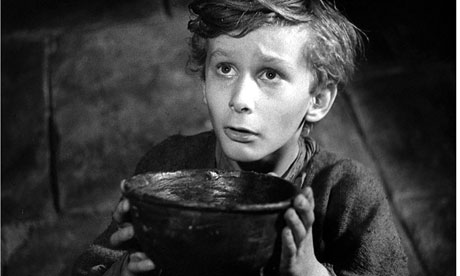
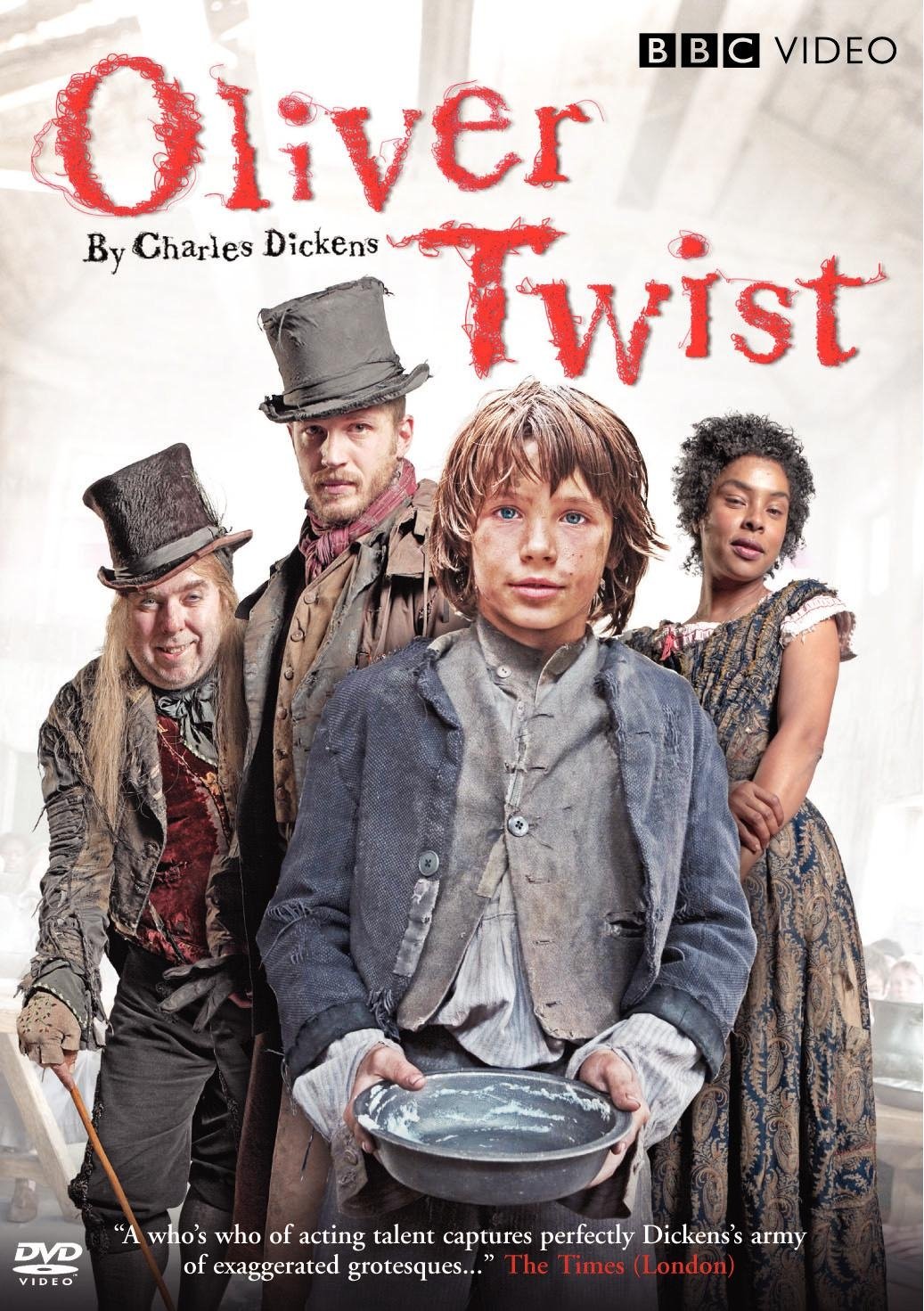
An iconic scene, but notice the camera cord?
Way back in 1982, Newsday critic Harriet Van Horne wrote, "why, when TV has access to a vast treasury of literature that has never been dramatized, why another go-round with "Oliver Twist"? And if Dickens is called for, why not his last brooding tale, "The Mystery of Edwin Drood"? It's just possible that audiences have had their fill of plucky little Oliver and his bowl of gruel."
The original article may be found here:
She goes on to write how "most of us cherish memories of the 1948 Oliver, and we're still singing tunes from the Lionel Bart musical."
And, of course, she had a point bout Edwin Drood, and still does, in spite of a fairly recent BBC adaptation.
But back then, then I never even new the story at all. I'd say I'd never heard of Oliver Twist, back in the eighth grade in 1982, save for small advertisement for a cartoon version the previous year. Technically, was not the movie itself that I was aware of: it was the teleplay in Scholastic Scope, a mag for Junior High (now Middle School) age kids that I was introduced to it, one week before it aired.
I never even knew there were other versions, let alone a musical! A musical based on such a story as this, about a ill-treated starving waif was difficult even to imagine when I first heard it. I'd heard strains from "Consider Yourself" back in sixth grade choir, and "Food, Glorious Food!", but I never knew what they were from.
This version, was of course THE version. But nowadays, with a whole other generation growing up, there are likely fans of the story out there who have their own, more recent, cinematic Olivers, and for them, 1982's Twist (AND the ones proceeding it) just don't register that much.
That's right: if 1982's Oliver Twist seemed like an unnecessary re-hash to the older generation of OT fans back then, what do they think now? It wasn't just this single critic that voiced the opinion, it question of whether a new Oliver was necessary was even discussed and defended by the filmmaker's themselves. Producer William F. Storke came to the film's defense, saying "I don't think once every thirty-five years is too much. When the 10th version of Oliver Twist shows up in 2017, it'll have a long way to go to beat what we saw in 1982."
I agree. As I type this, we're not quite there yet, but once again irony rears its head. Storke, director Clive Donner, and screenwriter James Goldman, the three men who made 1982's
Twist what it was, have sadly passed away. But
Oliver Twist has already been filmed a total of a total of
five times since then, and that's not even counting the animated versions and one pastiche.
OT is the second favorite Dickens tale for filmmakers after
A Christmas Carol, and actually I am indeed curious as to why, as the story itself does not seem to be gaining popularity. Scrooge's story will, I'm certain remain timeless. With Oliver, I'm a bit less certain. But I digress. Here are the adaptations, not counting the stage versions and other obscurities before the advent of film.
There were some earlier silent versions, most or all featuring girls in the role of Oliver, but I've never seen any of them, which makes the first one...
1922
This version, featuring Jackie Coogan as Oliver and Lon Channey as Fagin is actually quite a bit more true to the source material than the much heralded 1948 version. Unlike most versions to follow, the entire plot of the novel is intact, including both Oliver's early rescue by Brownlow from the magistrate Fang, and the burglary at Maylie's. Reportedly, the young actor was frightened by Lon Chaney's appearance in make-up, and ran screaming!
1933
This version is not a favorite with critic or fans, and frankly, I don't much care for it myself. Oliver is too young, the Artful Dodger is too old, and they totally eliminate the Sowerberry incident, and Oliver's fight with Noah Claypole.
1948

This is the version, starring Alec Guiness as Fagin, John Howard Davies as Oliver, directed by David Lean, that is most often believed to be definitive of all versions, before or since. I don't really see why--not that it isn't good.
It was infamously banned in Germany following protests by Jewish groups; watching the film itself; Guiness's overly stereotypically facial makeup make him a virtually a racial caricature--much, sad to say, the way Dickens himself wrote him in the first place. And they leave in the scene in which Fagin infamously thrashes Oliver. Most subsequent version eliminate it, and also try to "correct" the stereotype perpetuated by both Dickens original and Lean's version.
But that's not why I can't see it as definitive. Lean's version totally eliminates the burglary scene, and thus the Maylie family and Oliver's aunt, along with many very important scenes.
He also includes a climactic scene (for better or worse), in which the fleeing Bill Sikes kidnaps Oliver and uses him as a hostage. This fabricated incident has shown up in subsequent versions. It seems to me that if anyone threatens Oliver at the end, it really should be Monks, trying to accomplish physically what he was unsuccessful in doing by manipulating others.
Probably the film's greatest asset is that John Howard Davies actually resembles a child who has been starved half his life. His face just naturally has an emaciated look; this is in marked contrast to the other onscreen Olivers, most of whom look too healthy for a boy raised in a workhouse on watery gruel.
1962

This little-known and hardly recognized version ran on the BBC in 1962, reportedly shot in black and white, and is possibly the version that is most true to the book, far more so than the much heralded 1948 version. I've never seen it, but recently a petition ran to release this on DVD, which sadly didn't seem to have garnered enough votes.
https://www.change.org/p/british-broadcasting-corporation-bbc-release-the-1962-serialisation-of-oliver-twist-onto-dvd
Leaves no characters out? This one would be well worth seeing. Strangely enough, Bruce Prochnik, the boy who plays Oliver in this, was also the title role for the original Broadway production of
Oliver! Hard to believe, but it seems to be true.
Oliver! (1968)

Lionel Bart's 1968 muscial version seems to the one most people are familiar with, often the first they encountered the story. This film was released some years following the Broadway production, the first showing in London's West End, and the show has been reproduced many times since. It is a huge, rollicking production, vibrant with music and song, which also means it isn't very true to the book. Emphasis is given to the Artful Dodger's rogueish charm, and Ron Moody turned Fagin into a lovable old coot. Dickens wanted to get away from the glamorization of crime, which was prevelent in the popular novels of Jack Sheppard, a real life "heroic" rogue. While most of OT's baddies are intentionally morally repugnant, Dodger, it must be said has a bit of charisma lacking in the rest, which has made him a popular character ever since, possibly more so because of this film. Dickens may have realized that Dodger was problematic for this reason, and that may be why he essentially wrote him out of the story, and concentrated on the more evil characters. And since Dickens essentially left has character's story untold, pastiche writers have enjoyed speculating on what adventures he might have had, both in the colonies, and if he returned to London.
That's fine and good if you're a fan of the Dodger. But as for the movie
Oliver!, it goes almost in exactly the opposite direction then the book, so far as emphasizing the ugly reality of London's underworld. The movie also follows Lean's version in having Brownlow turn out to be Oliver's grandfather, and eliminating Oliver's aunt. But unlike in that film, Monks is entirely absent, strange since he's such an important part of the story.
1982

Somehow, I think
Clive Donner, who directed 1982's
Oliver Twist , also happened to have been assistant director to Lean's 1948 version. When it came to filming his own version, he told reporter's that, "I didn't worry about the impression that filmgoers may have retained from David Lean's production. What I had to fight was the more recent memory of the musical version of
Oliver." Donner said the musical had a "Christmas card look," and that "I purposefully chose to film many scenes in browns and mudcolors. The tale is a dark one, and I had to preserve the mood if the tale was going to work with proper impact."
Donner also told the press that there were other areas of the film that Lean's version did not touch, and that his new film set out to explore. That's all true, but at the same time Donner's film suffered from the same mishap as had Lean's: it was shoehorned into a measly two-hour space. While Lean's supposedly definitive version eliminates the burglary at Maylie's, Donner's version goes the opposite route, and eliminates entirely Oliver's rescue by Mr. Brownlow, and his recapture by the thieves. As it is, the protagonist's adventures are cut almost in half. But while the plot remains significantly wanting, this version is spot-on when it comes to the darkness of Dickens' original vision.
The script, written by James Goldman (who also penned the scripts for
Nicholas and Alexandra and
The Lion in Winter) also has Brownlow and Rose sharing the same estate, a trend that would be followed in subsequent versions, and makes Rose Brownlow's niece, thus by implication, Brownlow is Oliver's great uncle. The role of Monks is actually emphasized in this version. The murder of Nancy by Sikes is graphic and heart-rending, nearly as much as in the novelnitself. This is reportedly also true of the near-mythic 1962 version (which reprotedly generated contorversy because of it), though with most versions, this scene takes place behind closed doors.
"
Oliver is a rebel," said Donner. "He stands up for what he believes is right despite the consequences." Unlike in the book, and other previous versions, Goldman's script has Oliver willfully asking for more gruel for another starving boy, rather than the boys drawing straws and Oliver losing. This is very notable, making 1982's Oliver a creation of Donner of Goldman, based on Dickens's original character; the book's Oliver demonstrated passive resistance, but strident rebellion, as he does in this poignant scene. Producer William F. Storke, opined that actor Richard Charles had the "sickly and saintly" look that he was was searching for. I can't argue with that.
1985
 It's notable that a mere three years following Donner's adaptation, another version appeared, once again by the BBC, as in 1962. It's also noteworthy for the only version to have two actors playing both a younger, and slighter older Oliver. I was already used to 1982's version when this first aired, but it must be said that it is meticulously true to the plot of the book, even to excess, as were almost all BBC versions around this time. John O'Conner, critic of the New York Times observed, accurately, that this was a closer to Dickens version than most, and that Fagin, portrayed here by Eric Porter, is "more or less as Dickens wrote him: Fagin is Jewish and he's a villain."
You can read that review here:
http://www.nytimes.com/1986/01/07/arts/a-closer-to-dickens-oliver-twist.html
O'Conner had previously criticized 1982's Oliver, mainly focusing on George C. Scott's Fagin, whom he called "sanitized." The more sympathetic Fagin played by Scott was recently defended in "Please Sir, i Want Some More: Clive Donner's Marxist Verison of Oliver Twist."
https://www.questia.com/library/journal/1P3-2193255371/please-sir-i-want-some-more-clive-donner-s-marxist
It it also worthy of note that Lysette Anthony played Agnes Fleming, Oliver's mother in the opening sequences of both 1982 and 1985 versions!
1997

Back in the good old early days of the Disney, they broadcast a number of excellent movies, like
Dune (the extended cut),
My Fair Lady, and such Dickens-inspired tales as
The Whipping Boy and
Wolves of Willoughby Chase, and the 1982 version of
Oliver Twist with George C. Scott and Richard Charles. This last certainly went well with the mix, even though it seemed too dark for the Disney channel, especially the death of Nancy. Oddly enough, none of these films were Disney, but heck, I watched them all, and nothing at all on Disney interested me after they changed to what might be more accurately titled "Teen Central."
But in 1997, Disney made their own official version of
Twist, and, rather predictably, it's considerably less dark than most previous versions or its source material. Deviations from the book abound. Most striking early on is the absence of Bumble, the only such absence I'm aware of. The Sowerberry incident is (as I recall) left out as well. As with 1982, Brownlow and Rose share the same estate, though in this case both Oliver's recapture and the burglary are there, though this time the burglary is successful. Fagin is adaquely played by Richard Dreyfess, though he's certainly less evil than in the book. He also survives until the end, and Oliver even gives him a grateful hug. Strangely, the scene in which Fagin beats Oliver after his recapture is left in. This version has an overall lighthearted feel to it, almost like the musical, with Dodger telling Oliver about the fun, rollicking life as as a thief, even refering to Newgate as "the great institution of higher learning." It's full of other thieves--get it?
Another deviation is having Oliver "stealing" his mother's locket from the workhouse matron; one might consider that a strike against Oliver's moral character, but I disagree. It's the workhouse matron who's the real thief; Oliver is merely taking back what's rightfully his.
1999
The 1999 version is distinctive for first providing a back story, in which we actually get to see Oliver's mother, and how she met and fell in love with Leeford, later to be betrayed. This is both good and bad; its good that we get to see this background firsthand for those curious about the background details of the story; but not so good, in that for those not yet familiar with the story, there's no mystery to solve as far as Oliver's parentage is concerned. A relationship between Monks and his mother is introduced to the plot, something a bit unnecessary, which has led some to complain that this version ought to be called "monks and his mother." Fagin is portrayed as a East European conjurur, which if he were of Eastern European Jewish origin, he might well have been.
2005

This version, Filmed by Roman Polanski, and staring Barney Clark as Oliver, was the first version to be shown on the big screen since 1968's
Oliver! , at least in the US (1982's version was shown in the UK in London's West End and then in Europe). This version includes both Oliver's rescue and recpature, and the later burglary at Maylie's. It was shot in Romania, which the director reportedly thought resembled Dickens' London than modern London did. Somehow I get the notion that the Dodger has led a troubled life in this one, and his character is better for it.
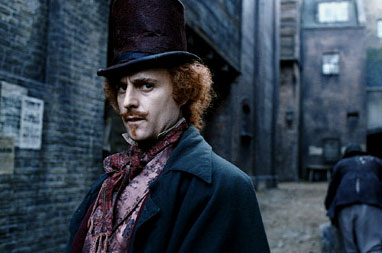
Surprisingly, this version includes Toby Crackit, Bill Sikes' s partner in crime during the burglary, a character that seldom seems to make it on screen.
2007

This is yet another BBC production of OT, this one deviating from the book far more than the others. The recent trend at the BBC is make their Dickens adaptations edgy and almost modern. The soundtrack to this quite jarring and doesn't fit the story very well. Fagin is played by Timothy Spall (most know as Peter "Wormtail" Pettigrew from the Harry Potter movies), who briefly appeared as a constable at Dodger's trial back in 1982! His is quite possibly the least Fagin-like of Fagins to come down the pike. This is mostly in his appearance; George Scott was a large healthy man, unlike Dickens's "old shriveled Jew"; Spall is positively rotund. If Scott made Fagin more sympathetic than Dickens had, Spall''s take on the character is even more so. His Jewishness is emphasized, including his religous aversion to pork. At Fagin's trial, he is even bribed by judge Fang into converting to Christianity, which he refuses. This film aslo features the films first ethnic Nancy. The director, in the DVD's "making of " feature, said the she is seeing White actors in these roles, so this casting seems done far more out of fairness than accuracy. It is
possible, that Nancy could have been a black woman in Victorian London; it just isn't very likely.
But the greatest deviation here is the character of Monks, who is portrayed as the grandson of Brownlow. He is also probably the most oily, hypocritical, and loathsome version of the character to date. That's fine , save that Brownlow's character suffers as a result, as Monks is shown to have gotten hold of the old man's ear, and manipulating him into distrusting Oliver, and forcing Rose to marry him. This is a far cry from the book, and certainly Micheal Hordern's portrayal, in which Brownlow serves as the sleuth who deciphers Oliver's parentage and brings Monks to justice.
This version also follows the trend set in 1982, with Rose as Brownlow's niece. Also like Donner's version, Oliver asks for more on his own gumption. In fact, this Oliver is even more defiant; you can tell in the "more" scene, that he is actively making a protest. When taken before the workhouse board, Oliver actually chastizes Limpkins and other board members, who are shown stuffing themselves. This is one gutsy Oliver! I'll submit that 1982's Oliver was actually the most heroic, in that you could see that he
was terrified when he took his friend's bowl up---but he forced himself to do it anyway. As Donner said, he did what was right.
Then, again, I'm biased. Oliver's defiance of Limpkins in 2007 was arguably better than 1982, as Oliver is basically passive in that scene.
Animated Versions
There's been a number of these
, most of them fairly cheap, nothing on par with the best of Disney
, unless you count
Oliver and Company, which I don't
. Here are those that I've actually seen.
Unknown, Australian Company

This is a version that was par of a series of animated Charles Dickens tales, produced in Australia and also included
A Christmas Carol,Nicholas Nicholby, and
Great Expectations. It was made in 1982 or around the time, so note the resemblence on the cover to 1982's Oliver. It's the same (I think) as one that's been released on DVD more recently.
Filmation

This is the one that holds a special place in my memory because it is the literally the very first time I ever knew of the story's existence or the name "Oliver Twist" at all. One day I just happened to chance on this ad in TV guide back in April of 1981. Uncanny, a bit, that the confused looking, wide-eyed waif in the picture should somewhat resemble the lad holding out a soup-bowl on the cover of
Scholastic Scope, nearly a year later. Before then, virtually all I associated with the name 'Charles Dickens' was Scrooge, and I sometimes wondered if he'd written anything besides. I'd read the scope issue on
A Tale of Two Cities just a month of so earlier, and seen part of the TV movie. "A brave orphan caught in the clutches of thieves?" I'd never heard of that before. Now I knew of three stories he wrote. I never saw the cartoon, curiously enough, since I had so much else on my mind in those days, until much later.
Filmation was best known back then for producing kid's shows for Saturday morning, before the advent of cable channels. The company was second only to Hanna Barbera in output. Their take on
Oliver was a muscical, but it featured all-new numbers totally different from
Oliver! , the Broadway muscial and 1968 movie.These were sung by Larry Storch and Davey Jones, popular musicians of the 60s and 70s. The story is true enough to the source material, but like Lean's
Oliver which seems to have set a trend, it leaves Rose maylie, Oliver's aunt, totally out (though it does include a botched burglary--Sikes leaves Oliver in a ditch after he's shot, and Nancy rescues him). Since Filmation had a way of including cute animal sidekicks, Oliver has a pet toad he calls squeaker, who he rescues and they become fast friends.
Saban's Oliver Twist
This was an animated Oliver
series made in the early nineties around the time I was in college. It took place in an alternate animated London populated by both anthropomorphic animals and humans. Oliver is a puppy, Dodger is a rabbit (or hare), Charley Bates is a gluttonous pig (literally), Fagin a wise old fox. Nancy is also a fox (as in the animal). I can't recall what Bill Sykes was, as he appeared very infrequently. I never paid this show much attention back then, though I vaguely knew it existed. I've since seen some of the episodes on youtube. The animation is pretty cheesy--no surprise. Since it's a series, it can't really follow the story, though the premier episode does have Oliver asking for more. Fagin's gang are Oliver's pals and mentors, pretty much. Also, in this version Oliver's mother is still alive, and most of the episodes involve his and the gang's efforts to find her.
Pastiche Versions
There have been
a number of Oliver Twist pastiches, almost all of which feature the Dodger as a (if not
the) main character, most of which are print, but a few of which are film versions.
Oliver and the Artful Dodger (1972)

This Hanna-Barbera produced this animated pastiche originally aired in 1972, as an entry of
The ABC Saturday Superstar Movie, a show that featured a different special cartoon every week (some of which were try-outs for series). There was the premiere for Filmation's
Brady Kids, a
Banana Splits cartoon/liveaction feature by HB, an animated
Lost in Space , an animated
Munsters, and more
. I didn't actually know of this cartoon until much later. The show has a number of things going for it. The plot has Mr. Brownlow dying, and his wicked nephew, Mr. Sniperly (a good Dickensian name!) seeking to claim Brownlow's will (and Oliver's inheretence) for his own. It's up to a reformed Dodger, and his gang of urchins to recover the will, which is hidden in the drawer of a piece of furniture. That's an intriguing plot, but it bothered me how untrue to the canon it is. Throughout is the implication that Oliver will be sent back to the workhouse if the will is not recovered. Why wouldn't Oliver just go live with his aunt? There was no way they could send him back, once they knew who he really was. This seems to be more of a sequel to the musical than to anything else, and that version, like some others, eliminates Oliver's aunt entirely. Oliver wasn't just a foundling that Brownlow happened to take in, and this story seems to assume this. Also, like the musical, there are songs throughout, though I didn't find them very memorable, unlike both
Oliver! and the Filmation cartoon.
The Further Adventures of Oliver Twist (1981)

This is an obscure TV serial made back in 1981. It has never been released on VHS or DVD, though some Brit kids remember it airing as a kind of after school special back then. I did however, manage to get the book on ebay some years ago. It's not bad. Dodger escapes being sent to the colonies, and somehow ends up at the same public school to which Oliver has been sent by his guardian, Mr. Brownlow, run by a Wackford Squeer-like headmaster. Monks and Noah Claypole both return to make trouble for Oliver. The writers are taking some liberty here, because Monks was sent to prison in the original, and later left for America. Oliver and Dodger find themselves on the streets once again, and eventually meet up with Fagin, who we learn has managed to escape the gallows. Oliver regains his fortune, and the villains are put in their place. The story has a rather satisfying fate for Claypole in particular, who ends up getting thrown in a cell with a criminal he has peached on. I always thought that Dickens let Claypole off too easily.;Oliver may break his nose in an earlier scene, but the Sowerberrys and Bumble take his side, and he eventually gains a fairly satisfying life as an informer.
Escape Of The Artful Dodger
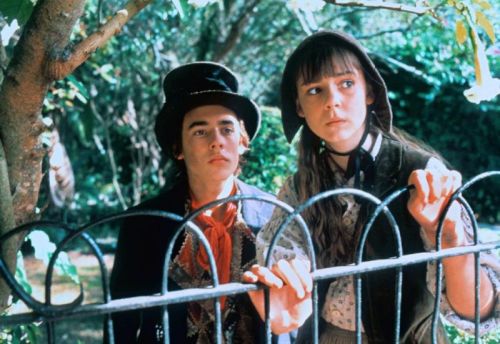
This pastiche goes the other route by following Dodger's adventures in Australia (how many readers have wondered about that?), only Oliver is sent to learn a trade on the same ship transporting Dodger by Mr. Brownlow. There is some Dickens mash-up going on in this, as two characters from David Copperfield turn up, Mr. Micawber and (an older than he should be) Uriah Heep. Fagin turns up in Australia as well, and this time, I'm not sure there's a credible explanation for him being alive. Early on, Dodger runs across a man who seems to be a young Charles Dickens. Some liberties have indeed been taken, as Brownlow is Oliver's grandfather, a noncanonical trend starting way back with David Lean's version and the musical. New characters are introduced, including female members of an Australian gang of street children.
And that's about it, so far as screen versions of Oliver Twist are concerned.
Has there ever truly been a definitive version? Possibly not. I'd like to defend 1982's
Twist as being such, but it isn't, really. No so much because of George C. Scott's overly sweet, Amercanized Fagin (where most critics seem to place the blame), but because so much of the story is left out.
If
Oliver Twist is indeed ever made on film again, whether in 2017 or afterward, what approach should they take? Well, as far as Fagin (the role that gets talked about most), they should have no problem with him being a bad guy; his Jewishness need not be overemphasized. As others have pointed out, Monks and Sikes are far worse, not only in subsequent film versions, but in the original as well.
More problematic is (or should be) finding a new boy to play Oliver. An actor with a heart-wrenching expression that outdoes that of 1982's Oliver would be
very hard to find, I imagine.
The script should follow the book. Some have disagreed a bit on this, but to have the substance of Dciksn, the film should run at least four hours. It need not be as stretched out as most Dickesn adaptations were back in the eighties. Had 1982's
Oliver run for two nights rather than one, the length would have been fine. Two hours was plenty to do justice to 1984's
Christmas Carol, also directed by Donner and starring George Scott;
Oliver not so much.
As far as acting skill, an ideal Oliver should be able to vocalize his actual lines in the text--something that, to date, I don't think has really been done. None of the on-screen Olivers has vocalized the character's pathos, though that's likely the fault of the script than the actual children playing Oliver. For example compare the following:
1982's Oliver: (Sikes is about to put him through the window): "Oh please don't make me do this Mr. Sikes! Please don't!"
Oliver from the Book:"Oh! for God's sake let me go!" cried Oliver; "let me run away and die
in the fields. I will never come near London; never, never! Oh! pray
have mercy on me, and do not make me steal. For the love of all the
bright Angels that rest in Heaven, have mercy upon me!"
Find an actor who can recite the above with that degree of Shakespearean pathos, in a heartrending soprano voice,
and also be terribly believable (not to mention ascript that follows the book), and a perhaps real definitive version of the tale just might be a possibility.