Wednesday, February 11, 2015

Where is "The Haunted Man"?


Charles Dickens' novella, The Haunted Man and The Ghost's Bargain presents an enigma in that it has not been adapted so much as once as a screen or even a known stage production since the nineteenth century. That's right---Dickens' ghostly tale of a gloomy chemistry teacher named Redlaw, haunted by wrongs done to him in the past, who encounters his ghostly double on Christmas eve has yet even to be filmed. Contrast that with the story of Scrooge, with more adaptations on screen and stage (not to mention parodies, animated, and sticom version, etc) than any other Dickens work bar none. Mention the name "Scrooge", and anyone will know the character. It would be very difficult ot find someone familiar with Redlaw's tale.

     The species of phantom Redlaw encounters, a duplicate of himself, is known to folklore as a "fetch". The phantom doppleganger is staple in paranormal literature. One also features in Edgar Allen Poe's short story "William Wilson."

    Dickens' Haunted Man was the last of his Christmas stories, which he began publishing annually following A Christmas Carol's roaring success, the previous ones being The Chimes, The Cricket on the Hearth, adn the Battle For Life. Of these, only The Chimes was another ghost story, about phantoms that haunt the bell tower, though it took place on New Year's Eve rather than Christmas. The protagonist of The Haunted Man, which, like Carol, occurs on Christmas proper, is so morbid about past wrongs (I think there's many who can relate to him), that he accepts the phantom's offer to obliberate all his unpleasant memories. The phantom's "gift," has unforseen consequences, as Redlaw becomes unable to express a loving nature--be becomes merely bitter and quarrelsome. Worse, his affliction spreads to others around him. The loving Swidger family and Tetterby family become...not so nice. It is only an innocent child character, Milly Swidger, who, because she remains uneffected by the affliction, is able to save Redlaw. the chemist recounts his bargain with the ghost, and all is restored to right and good by the end. The message hear, delivered in the final line by Milly Swidger, is that even painful memories of our past must be preserved in order for love and joy to exist in the present. That message, and the story itself, did not manage to resonate nearly as deeply with the collective human psyche as A Christmas Carol did. Still, the story seems to have been fairly popular on the stage following its publication. The story also includes a heavy dose of social criticsim of the times, just as in Carol and Chimes: at one point Redlaw encounters a half-wild "beast child," a sort of equivelent of Carol's Ignorance and Want.
 
     The reasons for its utter disapearance following the Victorian era remain unclear. Fred Guida, in his book A Christmas Carol and its Adaptations, relates that records show that one of the early stage adaptations featured a "flying ghost" onstage, and a later one was the first presentation of the "Pepper's Ghost" effect, very innovative for the time, in which the ghostly image of a human actor was projected onto the stage via a light projector, and through a pane of glass situated between the stage and audience. The effect was pioneered by polytechnic Henry Dirks, and presented on the stage by another polytechnic, John Henry Pepper, hence the name.
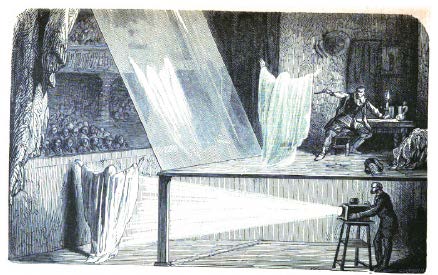
 https://skullsinthestars.files.wordpress.com/2012/08/peppersghost.jpg


Whatever the reason, dispite its early popularity, it's obvious by now that the story of Scrooge managed to totally eclipse that of Redlaw. I think it's time The Haunted Man was given its due on screen. Come to think of it George C. Scott might well have made a formidable Redlaw just as he did Scrooge. Scott was very good at depicting complex, conflicted characters in his movies. It's a pity he's no loger with us.

Here is an illustration of the fetch from the story:


 And some interesting illustrations for The Chimes:


Friday, October 10, 2014

Dickens and Shared Universe Fiction


Shared universe fiction, a modern term, refers to fiction that takes in a universe in which characters from different stories can meet and interact. Thus, the characters are members of a single "universe" or fictional reality, which is generally assumed to be separate from the "real world." Doubtless, this term (and the term 'aternate reality") did not exist during the 19th century. "Alternate history" seems to have had its origins with Joan Aiken's The Wolves of Willoughby Chase , the first of her "wolves chronicles," a series of YA books that were themselves Dickensian, set in an alternate 19th century, in which an underground channel was built between Britain and the continent, through which ravening wolves re-entered England and menace the English countryside. There is apparnetly even an alternate form of cockney spoken there, in which the word "naffy" roughly tranlates to the modern American slang "cool."

Dickens, of course, did not knowingly set out to create such fiction. But, in a sense, all fiction is alternative in that the characters and incidents did not occurr in reality--at least, not the reality we know. In regard to the concept of a "shared universe," that has to even more recent. Exactly when I can't say, but examples of it abound nowadays, the most extreme example being The League of Extraordinary Gentlemen comics (and film adaptation), in which all the fiction up through the early twentieth, as well as chacters of folklore and myth, happen to be real and historical. On a related note, author Stephen King, at some point in the career of his enormous body of fiction, decided to set most of his fiction in the same universe--read closely, and you'll references scattered throughout his work, at least later in his career, to his other novels. I said "most" because King scholars (and King himself) technically consider his work to comprise a vast "multiverse," set across innumerable realities, with the Dark Tower series and world being the central linch pin. Even without the Dark Tower, setting King's fiction in a "multiverse" would be a necessity, given that the futures explored in two of his Bachman books (The Long Walk and The Running Man)take place in very different dystopian futures, not to mention the post-apocolyptic world of The Stand, which never happened in his slew of recent books. Other authors, such as horror writer Brian Keene, have followed suit with King, and have connected their novels and characters as well.

But back to Dickens. In all of his canonical novels, there is not one verifiable incident where a character from one work crosses paths with another. Pastiches, however, are another matter. I've often speculated, for instance, on how a character like Jack Dawkins might cross paths with Abel Magwitch--after all, both were sent to Australia. An interesting subject for a pastiche, though I've actually found with all the Dodger pastiches out there, that someone's alread done that:

http://www.amazon.com/gp/product/1909609439/ref=x_gr_w_bb?ie=UTF8&tag=httpwwwgoodco-20&linkCode=as2&camp=1789&creative=9325&creativeASIN=190960943


So, then, it's suggested that least two of Dickens' works take place in the same reality. And with the subject of Dodger's adventures in Australia is on the table, I'd like cvall attention to Escape of the Artful Dodger, a Tv mini-series actaully produced in Australia. It, too, takes place in a shared universe, as is evident when both Mr. Micawber and Uriah Heep (from David Copperfield) turn up. The series also has Fagin escape the gallows, the same approach taken by The Further Adventures of Oliver Twist, another mini-series pastiche movie shown in Britain back in 1981. Escape also has the Dodger crossing paths briefly with a man who appears to be a young Charles Dickens.

That's another thing that pastiche sometimes do, and far more frequently than crossovers between novels. A great many pastiches seem to be built on the premise that characters actually lived, and that Dickens "fictionalized" their biographies.

Now, in my opinion, it's a bit more plausible in light of the shared universe, that 1) All the characters of one particular writer would inhabit the same universe, and 2) In that particular reality, the author himself would not exist. Perhaps in that timeline, Charles Dickens' parents, for example, never met.

In Robert Bloch's short story,"The Plot is the Thing," the protagonist becomes trapped in a "movie reality" where the characters of all the classic Hammer monster movies are real, but where their creaters--Gaston Laroux, Mary Shelly, Bram Stoker--do not exist.

http://biblioteca.mygeocom.com/wp-content/uploads/filebase/B/Bloch%20Robert/Bloch,%20Robert%20-%20The%20Plot%20Is%20The%20Thing%20%28v1.0%29.html

There would also likely be no crossovers with character not invented by Dickens, like say, Van Helsing in Peter David's Artful. Such characters would in habit their own relaities. There might also be a "waystation" reality, where one could travel to the different universe--but that's something else.

One other thing regarding Escape of the Arful Dodger, and I've noticed this in at least one other pastiche, is that Brownlow is Oliver's grandfather. The 1982 version of OT makes Browlow the great uncle. In the book, Dickens establishes no blood connection between Brownlow and either the Flemings or the Leefords. He's just a freind of Leeford, Oliver's father. The 1948 version made Brownlow Oliver's grandfather, though, and other versions, including the musical, followed suit to the point to where it's assumed to be canonical when it is not.

The concept of a shared Dickensian universe was taken to a comic extreme in a epsiode of the Charley Blake Show (which I mentioned in previous post), which has characters from a number Dickens novels owing money to Scrooge, including both Oliver Twist and Fagin. Then there was this interactive play, called Twisted: A Dickensian Murder Mystery, which took place at the Ebenezer Maxwell mansion in 2013. The setup is that an adult Oliver has been murdered, and characters from several of Dickens' works are suspects, including, as I recall, Miss Havishham from Great Expectations. Both author Dickens himself and his characters interact in order to solve the mystery.

http://www.freedomsbackyard.com/programs-events/murder-mystery-twisted-murder-a-dickensian-mystery/

While the above two instances take an approach to the material, in which all the characters interacting at once, there's another example that is only slight, and for that, a bit more contorversial.

Near the beginning to the fairly recent BBC take on of Bleak House, a "Mr. Brownlow" is spoken two in the courtroom discussing the Jarndyce  vs. Jarndyce case. Correct me if I'm wrong but I don't think this man's name is in the book at all. So was this the same Borwnlow in Oliver Twist, or perhaps a relation of his? In any case, a shared universe appears to be suggested by this adaptation.

Wednesday, October 1, 2014

Ebenezer: The Final Years of Scrooge


http://www.amazon.com/Ebenezer-The-Final-Years-Scrooge/dp/0981509185

This is a Dickens pastiche that I bought a few years back, and haven't gotten around to rading until now. I had read a sequel to A Christmas Carol much earlier called God Bless Us Everyone, which, among other things, untilized Charles Dickens as a character. In that case, the familair trope was used that the author used actual events  and people and fictionalized them.

Truth be told, this author does do something similar here, but the revelation doesn't occur to the end (and also raises additional questions), so I won't spoil it for anyone. As the subtitle indicates, this book is about Scrooge's final years. The author throughout manages to make the reformed Mr. Scrooge both grumpy and merry, not an easy task. We get to meet Bob Crachit's children and grandchildren, and we get to know the adult Tim Crachit quite well. The author does "cheat" a bit, unlike in "God Bless Us Everyone", regarding the line in the canonical tale stating that Scrooge "had no further intercourse with spirits." Scrooge has encounters with two possibly supernatural entities early on, one of which turns out to be a true ghost. Scrooge is visited by annoying (or annoyingly endearing) child named Jack. This scamp at first asks annoying questions, and begs to be told of Scrooge's encounter with the Spirits of Christmas, but he gradually seems to be other than what he appears. Then there is the frightening hooded enity, some like the Ghost of Christmas Future, who lurks in shadowy street corners, and later on appears to threaten both Scrooge and Tim Crachit. Tim, by the way, though having survived into adulthood, is now again having health issues, and a doctor informs him that he is soon to die...

Frankly, I found much of the middle portion of this take on Carol to be depressing. Scrooge suffers a terrible accident which leaves him dreafully disfigured, and the part about one of one of Belle's adult children blaming her troubles on Scrooge and seeking revenge is something the story could have done without. Tim slips into depression about what he thinks is his imminent death, and even seems to regret the fact that he was saved as a child. I actually felt some relief when Scrooge gave Time a badly needed wake-up at that time.

Fortunately, all does end well and happy for all in this tale at the last. I wondered for some time how the author was going to do it, but rest assured that she manages. The scenes with the reformed Ebenezer playing "pirate" with the Crachit family are heart-warming. The discription of how Scrooge feels when he again has a true supernatural experience is wonderful. A

ll in all, it's a book I recomend.

Brownlow's Social Class

There has been some confusion, it seems, over the years in regard to the social class of Mr. Brownlow in Oliver Twist. The same might be said to be true somewhat of Oliver's own, and that of his aunt Rose. Shortly after I was acquainted with the story of Oliver Twist, back in the day, my father assumed that Brownlow was a member of minor nobility, possibly a baron. In my otherwise excellent report on Oliver I did for high school (which was tragically stolen in a last-day-of school prank) I refered to him, in the paper, as "Baron Brownlow." This was of course, merely my (or my father's, who kind of idealized the nobility) speculation, and not even good speculation.
     It is generally agreed, based on the body of criticism I've read of Oliver Twist, that Brownlow was merely of upper-class gentry or bourgeois. I rememeber a "close up" in TV guide in regard 1982's movie (the first I really knew of the story) which indeed refered to Oliver's rescuers as gentry. Brownlow was a friend of Oliver's father who is referred to as a "gentleman," as is Oliver's villainous half-brother, in spite of his assoication with the underclass. Oliver's family on his mother's side, however, "may" have been nobility, and I've oftimes assumed, given that Agnes and Rose's father was a captain in the British navy, and most officials would tend to be aristos. This too, is speculation, however.
     In regard to Brownlow, some speculation remains there as well, as one review of the 1982 movie refers to Brownlow as "a benevolent country squire.' Possibly, he was indeed a squire, the same as Alworthy in Tom Jones, which is somewhere between the gentry and aristocratic classes. One other review of the same film in question--and a very negative one--Brownlow is assumed to be "aristocratic", but much of the other information in the review, both in regard to book and the film, was very innaccurate.
     However, the whole issue of Brownlow's social class does bring up the issue of how social class was regarded back then in regard to now. I've noticed that lots of modern critics of Dickens often find fault with his dealings with class idealization in his novels, and with Oliver Twist in particular. In short, Dickens appears very much to have favored the upper classes by presenting Oliver's family and rescuers in glowing terms. And though his novel exposed the plight of the poor, most inhabitants of the underclass are presented as evil. Dickens' own attitudes were, unfortunately, shaped the class-favoring society he was a part of. That he christianed Fagin, one of the principle baddies of Oliver Twist after Bob Fagin, an actual friend of his, because he was in horror of being "dragged down" to his class level, is well-documented. I would point to the events in Great Expectations as evidence that his former attitudes regarding his class status seemed to have changed and he became more self-critical and self-reflective later in life.
      In regard to modern attitudes though, I'm not particularly happy with how they have influenced some of the adaptations of Oliver Twist. These are most evident in the various ways filmmakers have gone out of their way to protray the members of the Fagin gang as victims of circumstance. This is most of obvious in the depictions of Fagin himself, hardly surprising, as he was the most controversial character from the start. Even in Dicksens' own time objections were raised. But even though every adaptation following the 1948 one "humanizes" Fagin to a certain extent (very notably Timothy Spall's protrayal in 2007), I can live with that. Since I was introduced to the "fatherly" Fagin of George C. Scott, it has always even seemed a bit harsh to regard Fagin as one of villains.
        But what really irks me in regard to modern sensibilities when it comes to Dickens is when they attempt to make the "good guys" less sympathetic, or worse, downright evil. And yes, this has been done in regard to Brownlow. In the 2007 version of OT by the BBC (whose adaptations nowadays are a far cry from what they were), they actually make Monks Brownlow's grandson. An odd move, but they do so for a purpose that soon becomes clear. Throughout most of the film, the conivingly rotten Monks (to his credit, the actor moakes him thoroughly despicable) has Brownlow wrapped around his finger. He even has his sights set on marrying Rose. Only at the end does brownlow discover the full, horrid truth about Monks. This contrasts markedly to both the book and the version I grew up with, in which Brownlow effectively functions as the story's master sleuth, diciphering each section of Monk's plan before finally exposing him.

    There is, however, a far worse portrayal of Brownlow out there, which I happened to stumble across over a year ago. This one happens to be a stage play put on TNT theatre in Britain:

 Jilly O’Dowd (Nancy), Eric Tessier Lavigne (Fagin), Dotty Kultys (Artful Dodger) and Alan Mirren (Lord Brownlow) in TNT’s Oliver Twist.

 http://www.timesofmalta.com/articles/view/20120229/arts-entertainment/A-fresh-twist-on-Dickens.408956

The above link contians a rather postive description. Draw your conclusions regarding this take on Dickens. However, don't be fooled: though Brownlow is described as "kindly" at one point, that's very misleading.  T o get an idea of the general feel of this, read the following:

"It also departed completely from the original narrative structure by turning Fagin into the primary narrator and having him, on the eve of his execution, converse in retrospect with Mr Brownlow as to who was to blame for the hardship and tragedy in the plot.

Who was to pay the ultimate price? Was it Fagin, who was in a sense a victim and manipulator of the circumstances which befell him, or was it Mr Brownlow, whose social prejudice and moral righteousness set the wheels in motion?" (Delicata)


   Obviously, this is not true to the book. The typical protrayal of Fagin as a lvoable rogue is taking at least one step further in viewing the story from his perspective. But what about Brownlow's "social prejudice" and "moral righteousness"? Simply put, they don't exist in Dickens' original. They have simply reinvented the character of Oliver's guardian for their own purposes. I have read the play itself, and I can state with confidence that the character of Brownlow has been almost totally villainized. A number of discrepancies exist. First, like the 1948 film, and many of the adaptations since, they make Brownlow Oliver's grandfather. The opening act has Brownlow actually has him cursing Oliver's mother for a harlot and casting her out on the street for having an out--of-wedlock pregnancy. They do Brownlow a small credit however, in allowing him to almost immediately regret this awful act. However, it's therefore plain form the start that in this mangled version, it's Brownlow who is the cause of Oliver's entire sorrid adventure! This is an entire flip of Brownlow's role in the story.
   And it gets worse.
   In the scene where Nancy "betrays" Monks to save Oliver's life, it's actually Brownlow who rats her out to the gang, breaking his former promise to her that he will tell no one. So, then, it's Brownlow who is to blame for Nancy's death as well! The whole thing begs the question of Oliver could possibly trust such a blackguard as this as his guardian. Realisitcally, he couldn't. Brownlow is just one more evil adult.
     The play ends with Fagin proclaiming that 'death' is the real story of Oliver Twist, and cursing Brownlow and those like him as the "real murderers", before he is hung. He also makes a genuinely heart-wrenching plead for who will look after the child members of his gang. A tragic finish indeed, with the enphasis on Fagin's demise rather than on Oliver liberation. A better light to shine on the plight of criminal underclass. But couldn't they have generating sympahty for Fagin's plight without turning one of the good guys evil?
     One interesting thing here in regard to issue Brownlow's social class. He is refered in this play, and no other adaptation that I'm aware yet, as "Lord Brownlow." In other words they make Brownlow an unspecified member of the nobility.
    Why? The answer is really obvious. It's the upper class, and not so much the bourgeois, who wield the real power, and it's them who are the ones to blame for society's ills. The whole haves vs. the have-nots thing. Plus, there seems to be a tendency in stories, perhaps in regard to this very sensibility, to make members of the aristocracy evil. I've seen it in too many places to mention. Whatever wisdom there is in blaming the aristos, Brownlow is just not himself here.


Delicata, Andre. "A Fresh Twist on Dickens," The Times of Malta.com Febuary 12, 2009. Web.


Wednesday, September 3, 2014

A Christmas Carol and its Adaptations


A Christmas Carol And Its Adaptations by Fred Guida, is a book I recently finished reading. I first learned of this book on Mr. Guida's site, Charles Dickens On Screen. This is a tome he authored himself, and it is almost unbeleivably comprehensive in regard to Carol adaptations. Every adaptation known to man is not only listed but examined, often in detail, from the very first versions known to be adapted (often plagerized) for the Victorian stage.

Given considerable attention in the chapter on televised versions are the George C. Scott version from 1984, and Henry Winkler's An American Christmas Carol from the late sevenites. This latter is notable, among other things, for taking place during the Great Depression. The point is made that oftimes the various versions of the Carol reflect the social climate and problems of their times. Clive Donner's version with George C. Scott may be seen for example as a critique of the Reagonite and Thacherite politics of its time (as can Donner's Oliver Twist, also staring Scott, filmed a couple years earlier). The Carol is, after all, a deeply mythic tale, one in which Dickens had apparently managed to actually tap into the collective human consciousness. It is a primal tale of death and rebirth found throughout religion and myth. That is why so many versions in so many places in time have cropped up, and continue to crop up, each holiday season. According to Paul Davis, author of the excellent Lives and Times of Ebeneezer Scrooge (which I also own and which Guida references) "We are still writing the Carol."

I learned quite a few things I didn't already know, including the fact that the animated Rankin/Bass feature from 1970s, The Stingiest Man In Town, was actually based on a previous live-action version staring Basil Rathbone of Sherlock Holmes fame, of all people. This version is, so far as I can tell, not available, which is a bit surprising. Sir Michael Hordern, famed actor of the british stage and cinema, actually made it into two versions, once as Marley, and the seond time as Scrooge. It's somehow strange to think of the soft-spoken Hordern as Ebenezeer, one thing Guida takes note of. The book also reveals that a sumptuous, and (according to Guida, at least) very good adaptation was filmed in France, the very same year that the famed Gearge Scott version premeired in America. This Frence version, sadly, is also not available, so far as I can tell.

The Filmography section of the book covers all versions of the Carol, and detail is given to those not included in the previous chapters. This includes all TV versions, all animated versions, all the versions that have cropped up on sitcoms at during the season over the years, and even "versions" that should perhaps be considered "semi-Carols." These are tales that, while clearly inpsired by the story of Scrooge, do not follow the same plot. One such film is My Little Boy, a film from way back in 1917, in which a Scrooge-like uncle disaproves of his nephew Fred's marraige. On Christmas eve the old curmudeon has a horrific dream in which he accidently kills his nephew's son, but wakes to the happy truth and as a result, becomes a a reformed man. A heart-rending film with a happy ending to be sure, though also, unfortuantely it is not avialable in any format. Also of note is a Christmas episode of "The Charlie Drake Show", a BBC serial in the UK back in the 60s. This "version" features characters from other Dickens novels, including Nicholas Nickleby, Pip and Miss Havisham from Great Expectations, and Fagin and Oliver from Oliver Twist, all of whom owe Scrooge money, and it's Bob Crachit's job to collect. I would have loved to seen this one, as it takes the "shared universe" concept to a whole new level.

In one chapter Guida deals with Dickens' other Christmas tales, and the curious fact that so few of them have been substanially translated into film. The Chimes, for example, has only recieved film treatment twice. Most unsual is that Dickens' The Haunted Man and the Ghost's Bargain" has apparently never been filmed at all. The story, virtually unkown to the public, invloves a chemist named Redlaw who encounters his own ghostly double one Christmas eve. This particular sort of phantom is know as a fetch in English folklore. The bargain concerns Redlw's desire to forget all the painful memories of his past. There turns out to be a major downside to this, until Redlaw manages, to see the error of his decison through the wisdom of the story's most innocent character.

Why has The Huanted Man never been filmed? Well, Christmas Carol, it seems, is so mythic in its essence that its resulting popularity has apparently drowned out all of Dickens' other tales. The reference to "scary ghost stories" in the song "Most Wonderful Time of the Year" often leaves people confused. Isn't there just one Christmas ghost story? Well, actually no. Guida does mention that The Haunted Man was indeed presented in at least two stage plays in the ninteenth century, one of which featured a "flying ghost." But sadly, the plays themselves no longer exist. One may hope that this and others of Dickens' Christmas tales may some day reach the screen.

All in all, a fantastic volume for Christmas Carol fans and well worth the reading.


Peter David's Artful


There have been numerous pastiches of Oliver Twist since it was first written. They are all rather obscure, but since Twist is probably Dickens' second most popular novel, quite a number of them do exist. The first I knew of was The Further Adventures of Oliver Twist , novel by David Butler, based on a TV serial shown only in the UK back in 1980. I finally read this when I purchased on ald paper back copy on ebay--not bad for a sequal, in spite a few inconsistancies. There was also Oliver and the Artful Dodger, a Hanna Barbera cartoon production shown on the ABC Superstar Movie, a Saturday morning series which featured different, often innovative cartoons by Hanna Barbera and Warner Brothers, back in 1972. Then there was the far more recent Escape Of The Artful Dodger, another Tv serial, this one shown on Australian televsion. There is also Dodge and Twist, by Tony Lee, and a proposed film with a different plot but the same title. Virtually every one I've come accross, with the possible exception of Oliver Twist Investigates by G. M. Best, features Jack Dawkins, aka The Artful Dodger, as a central character.

Then there are even a few works that focus that simply ditch Oliver altogather, and focus entirely on the more charismatic Dodger. There is Artful: The Dodger Down Under, by Martin Lake, following Dodger's adventures en route to the colonies and in Australia,and the more recent Dodge, by Terry Prachet, which appears to feature a facsimle Dodger character rather than the Artful himself. That brings us to the Artful by Peter David, and published early this year,  which focuses on the actual Dodger and his adventures upon escaping from the cololony ship and returing to the London streets. While certainly owing its existence to Oliver Twist, this is not a straight Oliver Twist pastiche, more like a spin-off. It should best be considered an Artful Dodger pastiche. It is also the first pastiche I'm aware that literally makes a case Dodger as the most intrigueing character compared to Oliver. The author makes this claim both in the blurb, and in the introduction to the novel itself.

One point the author makes here, one which I'd in fact really like to disagree with is, is that Oliver, even during his shinging moment of heroism whien he so defiantly asked for more gruel was essentially passive. Why can't I disagree? Becuase, as the author points out, in the original novel, the boys drew straws, and poor Oliver lost. I grew up on the the movie version in which Oliver heroically asks form more gruel for another starving boy. That truly is a shining moment of heroism, especially if you happen to be starving yourself--in the movie, at least. In the book, not so much. David does give Oliver credit, however, for bloodying Noah Claypole's nose, one incident, at least, in which Dickens allowed Oliver to take an active role.

David goes on to make another, darker, case regarding Dickens novel, namely that vampires were abroad on the streets  of Victorian London, but Dickens found them too disturbing to write abroad so he concealed this fact from his readers. Dickens did indeed steer clear from inclduing the supernatural, with the notable exception of his ghost stories---though there are some incidents throughout Dickesn that leave one wondering. David argues, with some validity, that certain points in Oliver Twist suggest that Fagin may well have been a member of the undead. Think about it, he always keeps to the shadows, is described as having rat-like fangs, etc. Yep, makes sense. It also gives the author a way to bring the old scoundrel back--after all, what would the gallows mean to a vampire? We also learn about Fagin's background, and exactly how it happened--an incident which seems to involve a certain Tranylvanian Count. The other suspected vampire form the original is police magisgrate Fang, orignally a minor villian who tries to sentence Oliver for stealing a book, and later sentences Dodger to deportation. I couldn't initially picture the slovenly, drunken magistrate I remmebered from the 1982 film version as a vampiric creature of the night, but David manages to make him a terrifying villain nonetheless, and very difficult adversary for Dodger.

We also learn quite a few things about the Artful's past and upbringing here, including the horrific and violent death of his mother. We learn the circumstances of how Fagin found and took him in, serving as a surrogate father figure. The novel also has Dodger eventually learning a secret regarding Fagin's past and his own which creates a rift between the old comrades. Later in the novel, there is incident in which Fagin considers their score settled, but Dodger refuses to forgive his former mentor. That's not, in my opinion at least, a highmark for Dodger's character, but it's a very human reaction nonetheless, so this Dodger manages to be dimensional as well as heroic.

The author gives his character plenty of opportunity for heroism throughout, inculding his rescue of (who he thinks is)a street girl from a drunken ruffian. The rescued girl turns out to be someone very important in connection to an enormous plot by the vampiric denizens of London to usurp the empire. The plot of this kind of reminds me of Wesley Snipes' comment in the movie version of Blade regarding vampiric control of New York: the world you live in uis merely the sugar-coated topic." It was that way back in Victorian London, as well, it seems. The fact that Mr. David is a famous writer for comics may not a coindence regarding his invention of a vampire infested Victorian age. It is also worth mentioning that this is not a straight Dickens pastiche; a good measure of Stoker and even Conan Doyle are in the mix as well, what with both the young Abraham Van Helsing and the Baker Steet irregulars getting involved. Note: Wiggings, the leader of the Irregulars, is featured here, but the author makes it plain that the leader of the Irregulars, which changes every several years, always assumes the name of Wiggins, as this tale takes place decades before the time of Sherlock Holmes. There is even a tie-in and explanation for the origins of the infamous paranormal rogue Spring-Heeled Jack and (just possibly) Jack the Ripper

 Artful is certainly a thrill-ride from start to finish, just as the author promises. But how is it as a Dickens' pastiche? Well, the Dickens characters are all representated accurately enough, provided the reader can accept the vampiric elements throughout, though there is one very slight exception. Oliver Twist himself has a couple of cameos in the novel, first near the beginning when the recently escaped Dodger glimpses him in a coach with Mr. Brownlow, and later when Dodger and VanHelsing arrive at Brownlow's posh estate to explain their predicement and warn of the vampiric threat. It is made fairly clear during this scene that Brownlow, while protrayed as basically decent, is a bit prejudiced toward these lower class ruffians, and wanting Oliver to have anything to do with them, not even telling Oliver who had was who had visited. In other words, David makes Brownlow a bit of a class snob, which means that he is--well, slightly off character. However, this is by no means as dreadful as a certain Oliver Twist play I am aware of that literally makes Brownblow into a villain--but I digress.

Artful, is, as said, an exciting read, and I'm wondering, perhaps, if a comic version might some day be in the works. Not likely, but a possibility since, David is, after all, in the comics field. If that ever happens, I hope that they get Berni Wrightson to illustrate it. I can just see some marvelous Wristson artwork for the scene where Dodger and Van Helsing enter a canrival "Cabinet of Horrors" featuring all sorts of stuffed monstosities. Take a look at some fo the stuff Wrightson has done for his ongoing Frankenstein Alive Alive! series, if you don't beleive me.

Saturday, August 30, 2014

Quigsnip: The Untold Tale of Charles Dickens' Oliver Twist


Here is the "Oliver Twist" pastiche story that I have just completed!


http://www.amazon.com/Quigsnip-Untold-Charles-Dickens-Oliver/dp/150063476X/ref=sr_1_1?s=books&ie=UTF8&qid=1409418750&sr=1-1&keywords=quigsnip


Here is an excerpt, BTW:

“You stole the money, Oliver! That you did! The money's here, Oliver!” Quigsnip held forth the familiar silk sack containing the inheritance money. “It's all here, Oliver! I checked! Oh, what a kind, brave, selfless, lad you are! Such a pity not one farthing will be spent on account of the children!”
N-no!” cried Oliver, his thin, soprano voice nearly breaking with anguish, “You're lying!” But in his despairing heart, Oliver knew his monstrous captor spoke the truth.
Am I?” roared Quigsnip, his voice filling with fury. “Just wait, boy, until the London Times runs the article! 'Oliver Twist Guilty of Robbing Shaftesbury's Charity!'” He snatched a letter from his pocket and held it out for Oliver to see. “And here is irrefutable proof of your guilt, and your personal indictment Dr. Losberne, right on this letter in your own handwriting! Not even your contemptible family can spare you now! Now, not even your dear Rose and Mr. Brownlow will believe you!”
NOOOOOOOOO!” wailed Oliver, in anguished misery. The boy fell on his knees, head downcast.
The men jeered at him.
Limbkins, though he would not liked to have admitted it, was terribly unsettled at the moment, more so now by the boy's harrowing cry.
Noah swaggered over to where Oliver slumped. “'Ow do ya like it now, Nolly?” the older lad sneered. “'Ow's that fer breaking my nose back at Sowerberry's?”
To Claypole's astonishment, the smaller boy sprang to life. Oliver sprang from his position like a stroke of lightening and drove his small, hard fist into Claypole's nose with savage force.
Noah reeled back, screaming and clutching his face.“My nose! 'Ee broke my bloody nose! Oliver broke it again!”
Oliver stood before his towering captors, tears of rage leaking down his cheeks, his small hands closed into fists.
What are you dolts waiting for?” Quigsnip ordered. “Get him!”
Oliver stood his ground, but there was nothing such a small, slim boy could do against the burly adults. They seized the frail lad and dragged him to the edge of a pier.
Now--”ordered the monstrous Quigsnip. “Bind him.”
The men bound Oliver's arms behind his back with heavy ropes. Two of them carried concrete blocks over to where they had Oliver bound.
Do his feet,” Quigsnip ordered.
They lashed the heavy weights to Oliver's thin legs.
As the boy stood in a stupor of despair, arms and legs bound on the edge of the pier, Quigsnip ordered his gang to step back.
Oliver was past caring. If what Quigsnip said was the truth, he didn’t care if he died.
Quigsnip stepped forward, an oily grin on his face. “And so I bid you a final farewell, young Oliver Twist. At last you've paid the price for the money I've lost, and for what your family did to me, the richest crime-lord in London! You'll serve as a prime of example of why no one ever crosses Zebedias Quigsnip and lives to boast of it! Know that that doctor friend of yours will pay along with you! Despair, young Oliver—and die!
With that, Quigsnip slashed out savagely with one leg. His booted foot smashed into the boy's middle with tremendous force. The wind knocked out of him, Oliver was propelled backward by the force. The bound boy flew of the pier. The polluted water surged over his head.
In seconds, Oliver was swallowed by the Thames.